
Microsoft Teams widgets
Widgets provide customisable analytical views designed to help users access the information most relevant to them. Each widget includes a predefined set of columns and filters and can be imported, saved, modified, and displayed within Prism.
The widgets below are available for Prism Version 25.03 and above. If you are using an earlier version of Tiger Prism and require assistance with existing widgets or reporting requirements, please contact the Customer Success Team at [email protected]. A member of the team can review your requirements and advise on the most appropriate reporting solution for your environment.
If you would like to upgrade and benefit from these newer widgets, please contact your Account Manager for further information.
Single-Person Meetings over 20 Minutes
Poor Audio Quality Call
SIP Termination Cause Total
Call Queue Analysis
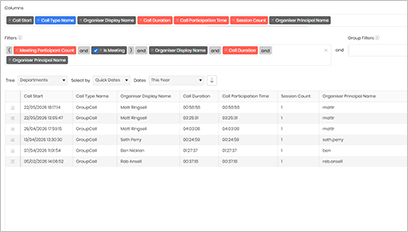
This widget is particularly useful for identifying calls where a user is marked as “In a Meeting” despite no other participants joining and waiting in this meeting with no other users for over 20 minutes, which can assist in better understanding team engagement and availability.
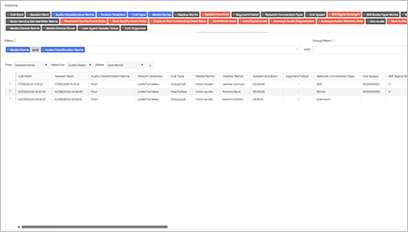
To search for poor-quality voice calls, a proactive approach involves monitoring call analytics to identify and troubleshoot issues. Call analytics provide detailed information about devices, networks, and connectivity for individual calls, allowing for a granular investigation into the causes of poor call quality.
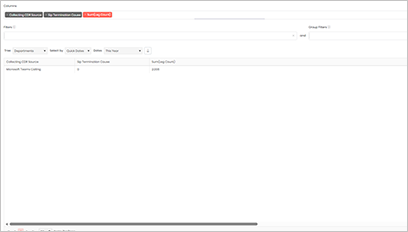
SIP Termination Cause refers to a code that indicates why a Session Initiation Protocol (SIP) call was ended. These codes are essential for diagnosing issues within VoIP (Voice over Internet Protocol) communications.
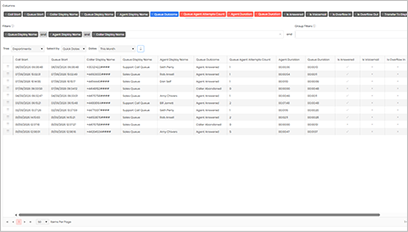
The Queue widget provides detailed visibility into queued calls, including the caller, queue, answering agent, call outcome, queue wait time, agent talk time, and any subsequent transfers. The widget can also be filtered by a specific phone number, agent, or queue, making it easy to investigate individual call journeys and queue performance.
Auto Attendant Calls by Hour
Sessions that go to Voicemail
Teams Audio Devices Usage
Emotive Feedback Overview
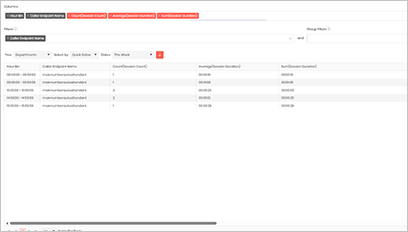
This widget will show you a summary of the calls going into Auto-Attendants by hour. This will not show where the caller went to once they left the Auto-Attendant as that information is not available from Microsoft.
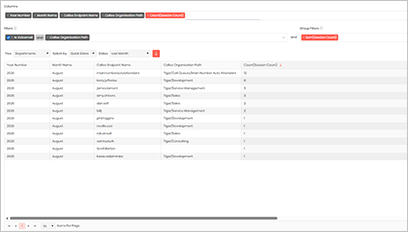
This widget provides a summary of the number of calls directed to voicemail for a specific URI, along with the organisation path the URI is associated with, sorted in descending order by the number of voicemail sessions.
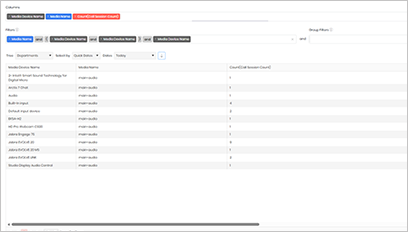
The Teams Audio Devices Usage widget provides a summary of the audio devices used during Microsoft Teams calls, ranked from the most commonly used device to the least.
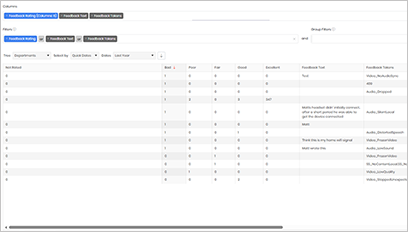
The Emotive Feedback widget summarises end-user ratings submitted after a call or meeting, showing how many users rated their experience as good, poor, excellent, or another available category. This provides a quick view of overall user sentiment based on feedback rather than technical call quality metrics.
Busiest DDI numbers into the business total calls and duration
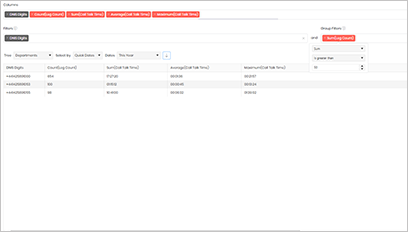
This widget summarises call activity by destination number (DNIS), showing the total number of calls, total talk time, average talk time, and longest call duration. By default, it displays only destination numbers that have received more than 50 calls during the selected reporting period, although this threshold can be adjusted as required.